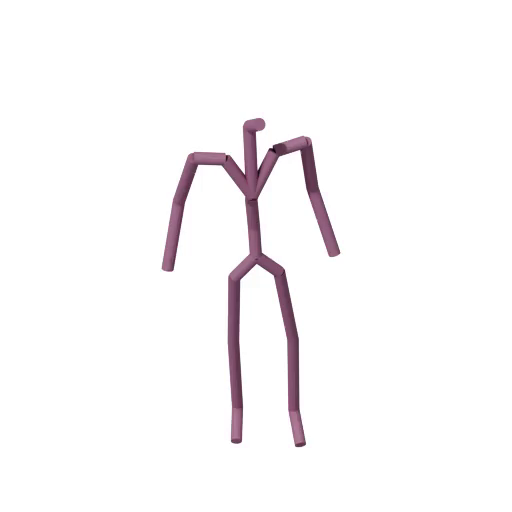
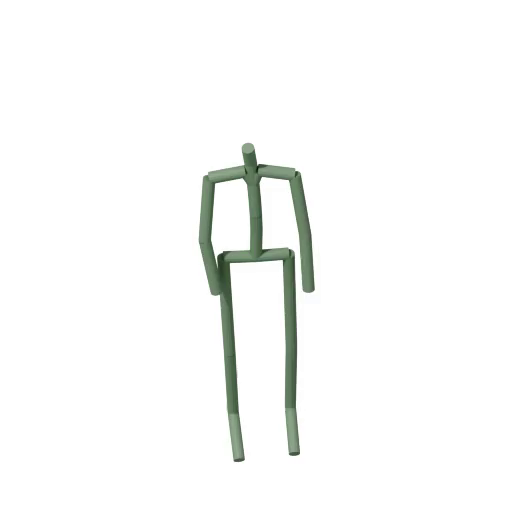
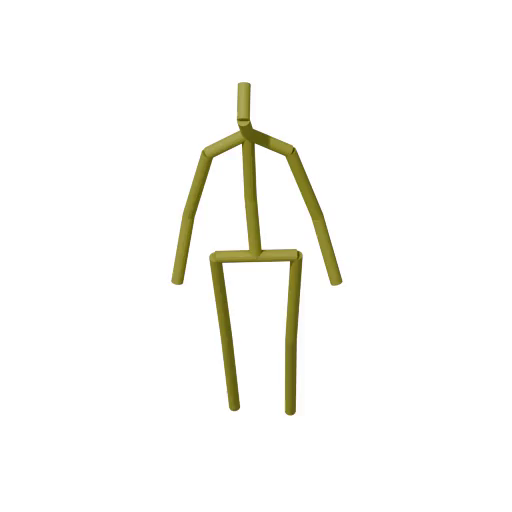
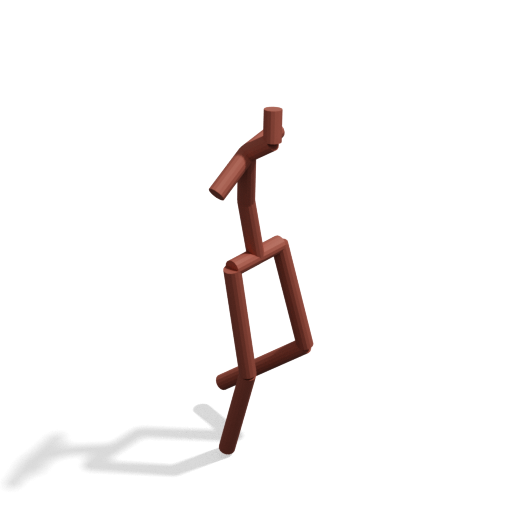
What does it take for one network to serve any skeleton? To handle arbitrary kinematic chains, a model's
learned weights must be independent of the number of joints and of their ordering. We identify
permutation equivariance as the key property: reordering the joints of the input motion
\(\mathbf{X}\) and of its adjacency matrix \(\mathbf{A}\) must simply reorder the output,
$$f(\mathbf{P}\mathbf{X},\, \mathbf{P}\mathbf{A}\mathbf{P}^{\top}) = \mathbf{P}\, f(\mathbf{X}, \mathbf{A})\,.$$
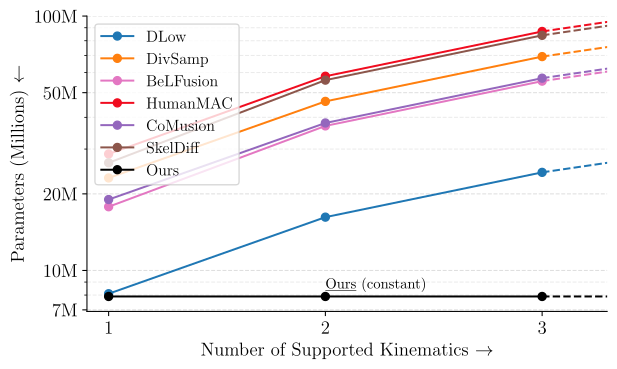
Lemma. Why cannot other methods do this? A model that accepts kinematic chains of any size must have a
parameter count \(|\Theta|\) that does not depend on the number of joints \(J\):
\(\tfrac{d|\Theta|}{dJ} = 0\), i.e. \(|\Theta| \in O(1)\). Popular motion-prediction architectures
intentionally learn joint-dependent weights to capture dataset-specific priors — and
therefore provably violate this constraint.
Theorem. What is a possible solution? For a general feature-extraction operation
\(o(\mathbf{X}) = \mathbf{W}\mathbf{X}\mathbf{G}\) on \(\mathbf{X} \in \mathbb{R}^{J \times F}\),
permutation equivariance under joint reordering \(\mathbf{P}\, o(\mathbf{X}) =
o(\mathbf{P}\mathbf{X})\) for any permutation \(\mathbf{P}\) implies that \(|\Theta|\) is
constant in \(J\). We prove that equivariance is a sufficient condition for handling arbitrary kinematics:
a guarantee obtained by construction, not by data augmentation.
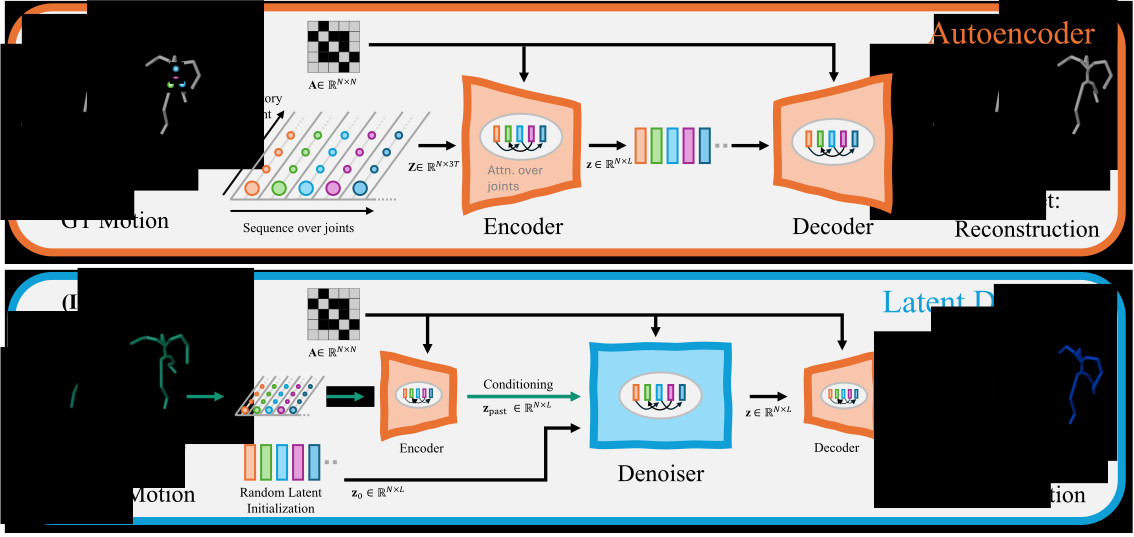
EquiFusion is built exclusively from operations that satisfy this
equivariance requirement, so the guarantee holds end-to-end: a transformer autoencoder maps motion sequences to a
latent space that preserves the joint dimensions, and a denoiser predicts future motion in this latent space, conditioned on the
embedding of the observed past. The skeleton's connectivity is an explicit input to every stage —
not a prior infused into the weights. And because nothing in the trained weights refers to a specific joint
set, the same model accepts any adjacency matrix at inference — the basis for the zero-shot
kinematics, occlusion handling, and limb generation shown above.
Equivariant by construction
Graph convolutions aggregate features not through a learned matrix but through the normalized adjacency
\(\mathbf{W} = \mathbf{D}^{-1}\mathbf{A}\), and attention runs over joint tokens without positional
encodings. Every layer commutes with joint permutations, so the full network does too — with a
formal guarantee, not data augmentation.
A new Parametrization: Bone directions
Each joint is encoded not as a position in 3D space but as the direction from its parent joint. Limb lengths stay consistent by design
— zero stretching and jitter. This parametrization transfers across kinematics and
improves existing SHMP methods too, without architecture or training paradigm changes.
Kinematics as an input
The adjacency matrix is a runtime input, not a design constant. One trained instance serves AMASS,
H36M, Nymeria, partial skeletons — or potentially any kinematics released in the future — with a
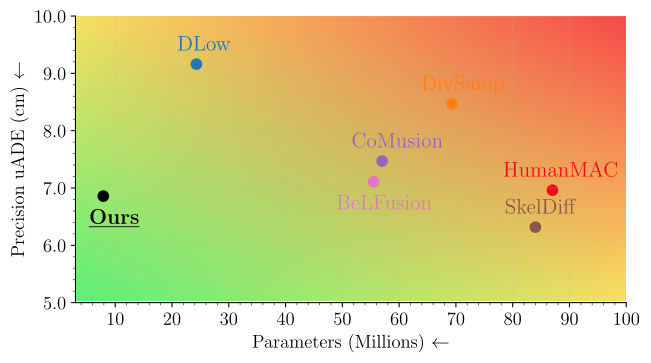
parameter count that stays constant no matter how many joints or datasets.